
Loading ...
Song Sparrow
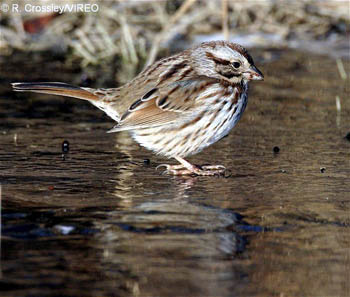
The Song Sparrow (Melospiza melodia) is a widespread familiar sparrow native to North America. In the northern half of the United States (except for the Dakotas and the Great Lakes where it breeds only) this Sparrow is a year-round resident; in the southern half of the country it winters. Two keys to the Song Sparrow's success have been its undiscriminating approach to breeding habitat (from riparian lowlands to suburbia to mountain slopes), and its modest territorial requirement (eight pairs have nested on a single acre). There is substantial geographic variation in the size and plumage of Song Sparrows - larger birds tend to be in the north, paler birds in drier climates. Although the bird's songs also vary, they follow a common pattern of three clear introductory notes on a single pitch followed by a jumble of notes and a trill at lower pitch, sung with gusto.
See all Song Sparrow photosField Marks:
The Song Sparrow has brown streaking on its breast, flanks, and back, a central brown breast spot, broad "malar" marks lateral to its throat, and a long tail (L 6.25 in.)
Distribution:
The Song Sparrow is a year-round resident from Vermont to Georgia and from the Aleutian Islands to Baja. In the Dakotas, the Great Lakes region and Canada the Song Sparrow is only a breeding bird. It winters in the southern U.S. and northern Mexico.
Similar Species:
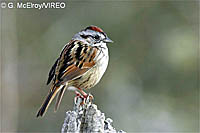 |
Swamp Sparrow (species account) (all photos) The Swamp Sparrow has a grayish breast, a more substantial amount of rufous color in the wings, a rufous crown (in the adult male), and, in winter plumage, olive tones on the face and nape |
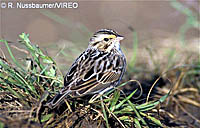 |
Savannah Sparrow (all photos) The Savannah Sparrow has a short, notched tail, fine streaks on the breast, and yellowish "lores" in front of the eyes. |
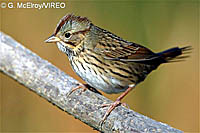 |
Lincoln's Sparrow (all photos) The Lincoln's Sparrow has warm buffy color in the malar area, buffy and fine streaking on the breast, and a more delicate overall appearance. |
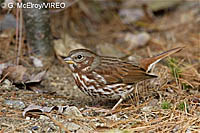 |
Fox Sparrow (all photos) The Fox Sparrow is larger than the song sparrow and has rufous or dark spots on the breast unlike the streaks on the breast of the Song Sparrow. |
Habitat & Nesting:
The Song Sparrow nests mostly on the ground in dense deciduous thickets.
More Information:
Each image is legally protected by U.S. & International copyright laws
and may NOT be used for reproduction in any manner without the explicit authorization of VIREO.
Terms and Conditions of Use
©2011-2015 All Rights Reserved, The Academy of Natural Sciences of Drexel University, 1900 Benjamin Franklin Parkway, Philadelphia, PA 19103
Tel: 215-299-1069 Email: vireo@ansp.org
