
Loading ...
White-throated Sparrow
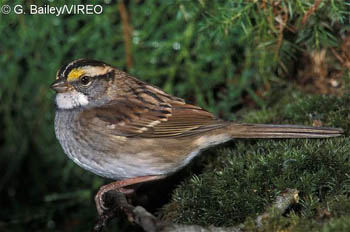
The White-throated Sparrow (Zonotrichia albicollis) is commonly seen foraging for seed on the ground near winter bird-feeders in the eastern and south-central United States and occasionally along the West Coast. The White-throated Sparrow continues to sing its ethereal, quavering song almost until the first snowfall: two thin, clear whistles followed, at lower or higher pitch, by a short note and three tri-syllabic phrases ("Old Sam Peabody, Peabody, Peabody"). There are two "color morphs" of the White-throated Sparrow having either white or tan stripes over the eye and on the crown. Field studies suggest that white-striped birds are more assertive in their territorial defense than tan ones. Interestingly, these birds tend to choose mates of the opposite color morph.
See all White-throated Sparrow photosField Marks:
The bird has a sharply demarcated white throat, white or tan stripes through the crown and over the eye and a black line in between, yellow patches between each eye and the bill ("lores"), and rufous coloration in the wings. (L 6.75 in.)
Distribution:
White-throated Sparrows breed in Canada, the Great Lakes region, and portions of New England and the Appalachian Mountains. It is a winter resident throughout the south-central and eastern United States and in coastal Oregon and California.
Similar Species:
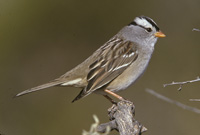 |
White-crowned Sparrow (species account) (all photos) The White-crowned Sparrow has a pinkish/yellowish bill in all plumages, broader black and white crown stripes, and no sharply defined white throat. |
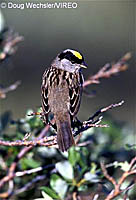 |
Golden-crowned Sparrow (all photos) The Golden-crowned Sparrow, common along the West Coast of the U.S., lacks the defined white throat and has yellow instead of white or tan on the crown. |
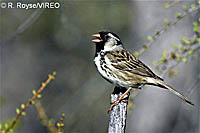 |
Harris's Sparrow (all photos) The Harris's Sparrow has an all-pink bill and a black breast-band. |
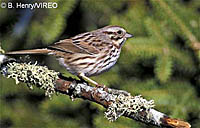 |
Song Sparrow (species account) (all photos) The Song Sparrow has bold brown streaks on the breast, a central breast spot, and strong malar marks on either side of the throat. |
Habitat & Nesting:
White - throated sparrows live in a wide variety of habitats from coniferous and deciduous forest to clearings with brush. They avoid the densest forests for nesting. The female builds the nest on or near the ground often near the forest edge.
More Information:
The clear-whistled song of three to seven notes is one of the most recognizable sounds of the north woods.
Each image is legally protected by U.S. & International copyright laws
and may NOT be used for reproduction in any manner without the explicit authorization of VIREO.
Terms and Conditions of Use
©2011-2015 All Rights Reserved, The Academy of Natural Sciences of Drexel University, 1900 Benjamin Franklin Parkway, Philadelphia, PA 19103
Tel: 215-299-1069 Email: vireo@ansp.org
